When Mangroves Speak: A Coastal Story of Climate, Community, and Accountability
-
Autoria
Ravi Rebbapragada
![]()
Guest contributor - Tipo de artigo Blog
- Publication date 20 Feb 2026
This blog was written by Ravi Rebbapragada, Executive Director of Samata. Samata was one of five Civil Society Organisations (CSOs) selected to receive the 2025 IRM CSO Advocacy Grant.
On a humid October morning in coastal Andhra Pradesh, the mangroves stood quietly along the creeks of Korangi and Hope Island, their tangled roots holding more than just soil. They held stories—of cyclones weathered, livelihoods protected, and communities that had learned, over decades, to live with the forest rather than against it. It was here that Samata’s journey with the Green Climate Fund (GCF) and its Independent Redress Mechanism (IRM) began—not in conference halls, but in villages where climate change is felt before it is named.
For many forest-dependent and fishing communities, the Green Climate Fund was an unfamiliar term. What they knew instead were canals being de-silted, mangroves being replanted, and forest guards visiting their villages more frequently. Through careful outreach and consultations with the Andhra Pradesh Forest Department, Samata helped bridge this gap—connecting everyday experiences of plantation work and canal widening to the larger architecture of global climate finance and accountability.
In Chollangi village, elders spoke with quiet pride about protecting MADA mangroves since the early 1990s. Long before climate funds arrived, local communities had patrolled forests, replanted saplings, and stopped illegal cutting. GCF-supported interventions, they felt, worked best when they strengthened this existing stewardship rather than replacing it. The conversations here were not one-sided; they were exchanges rooted in memory, labour, and local knowledge. As discussions deepened, a crucial question surfaced: What happens when something goes wrong? This is where the Independent Redress Mechanism entered the story. Samata’s outreach explained that communities are not just beneficiaries of climate projects—they are rights-holders. Whether it is delayed wages, concerns about canal excavation, plantation practices, or impacts on fishing livelihoods, the IRM offers a confidential and formal pathway to seek remedy.
At the Coringa Biodiversity Centre in December 2025, this idea took collective shape. Representatives from eight panchayats and twenty villages gathered—fishers, forest-dependent households, EDC leaders, and elected representatives. Posters were unveiled, pamphlets in Telugu distributed, and conversations unfolded about transparency, participation, and trust. For many, it was the first time global climate finance felt tangible and approachable.
Forest officials joined these conversations not as distant authorities but as stakeholders in dialogue. They spoke about canal de-siltation, plantation survival, and the technical goals of climate adaptation. Community members responded with questions about wages, work conditions, and long-term livelihood impacts. In this exchange lay the true spirit of the IRM: accountability not as confrontation, but as conversation.
Fishing communities added another layer to the narrative. Mangroves, they explained, are not just green buffers against cyclones—they are nurseries where fish are born before entering the sea. Protecting mangroves means protecting income, food security, and dignity. Their earlier struggles—resisting mangrove clearance for housing projects and approaching district authorities and even the National Green Tribunal—stood as reminders that community vigilance has always been central to environmental protection.
Across Korangi, Bairavapalem, and Hope Island, nearly 250 hectares of mangrove and forest areas now reflect these combined efforts. De-silted canals allow water to flow again. Saplings take root more securely. While climate adaptation is often discussed in technical terms, here it revealed itself through visible changes in landscape and renewed confidence among local custodians of the coast.
What made this outreach distinct was not just awareness of the GCF, but the normalization of grievance redress as a right. Communities learned that speaking up does not mean standing alone. The IRM exists precisely to ensure safety, confidentiality, and fairness—especially for those who are often the first to bear the costs of climate interventions.
As the programme concluded, the mangroves once again framed the horizon—steady, resilient, and alive. The story unfolding in coastal Andhra Pradesh reminds us that climate finance works best when it listens. When communities understand not only what is being done in their name, but also how they can question, shape, and protect it. In that space between global funds and local roots, accountability becomes not just a mechanism—but a shared commitment.
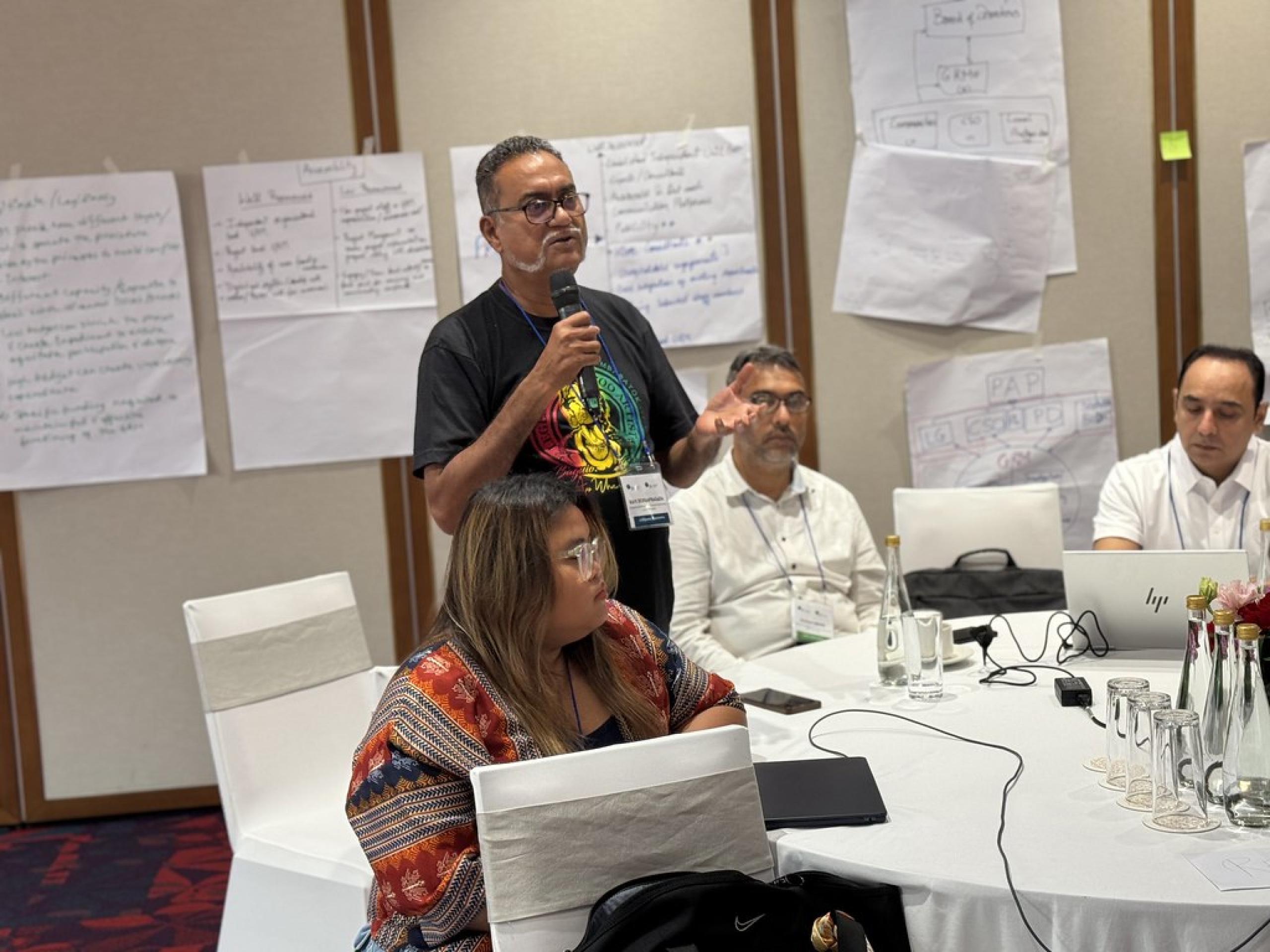
Ravi Rebbapragada at the IRM's workshop in Vietnam in April 2025.